
Content table
If you’re trying to conceive (or will be soon), you may be curious about the best timeline for stopping birth control.
When you’re on birth control, your fertility is temporarily on hold. But the good news is that most forms of birth control don’t cause any long-term side effects. That means when you’re ready for a baby, it’s possible to get pregnant soon after stopping your medication.
The exact time varies woman to woman and depends on the specific birth control method. But keep reading to get all the details on your chances of getting pregnant after stopping birth control.
Key Takeaways
- After ending BC, your cycle may take a few weeks or months to return to normal.
- The amount of time it takes to get pregnant after ending BC varies from woman to woman. It could happen pretty immediately or it could take a few months.
- After you stop hormonal birth control, you may begin to notice signs of ovulation. These could include egg-white-like cervical mucus and increased sex drive.
- Ovulation will happen before your period returns. This means it’s possible to get pregnant before you begin menstruating again.
- If you want to conceive after you stop birth control, tracking your hormones is helpful.
- If you’ve been off of BC for six months (if you’re less than 35) to a year (35+), you may want to consult a fertility specialist. They can advise you on your reproductive health and family planning options.
How Does Your Menstrual Cycle Change After Birth Control?
Different birth control methods have similar timelines when it comes to menstruation returning.
If you were using hormonal birth control, you may experience “withdrawal bleeding.” This is light to moderate bleeding that can last anywhere from two to four weeks.
Once that bleeding stops, your natural period will resume within the next few weeks. However, it may take up to 6 cycles for your menstrual cycle length and flow to normalize.
However, if you’re taking Depo-Provera®, things work differently.
A single dose of Depo-Provera® works by keeping you from ovulating for 4 to 5 months at a time. So if you’re using this form of contraception for birth control, expect it to take several months for ovulation and menstruation to return.
Another question you’re probably wondering at this point is: Can I get pregnant right after stopping birth control? Don’t worry, we’ll go over all these juicy details next.
How Soon Can You Get Pregnant After Stopping Birth Control?
There’s no set length of time it takes to get pregnant after discontinuing contraception.
The way that hormonal contraception works to prevent pregnancy is by keeping your ovaries from releasing an egg. So once you’re no longer on birth control, ovulation will return fairly soon. When that happens, you can get pregnant.
Some women may get pregnant right away after stopping birth control pills or removing their vaginal ring or birth control patch. But for other women, it could take several cycles or longer.
The major factors that determine the length of time to pregnancy after birth control include:
- How regular your cycle was before you started using birth control
- Your age
- Your overall health and fertility
- How frequently you have unprotected sex
- If you have any medical conditions that affect your fertility
One study of over 3,700 women did find that oral contraceptives may lead to slightly lower fertility in the first 2 – 6 months. (This is in comparison to barrier methods like IUDs and condoms).
Don’t let this worry you, though!
It doesn’t mean you can’t get pregnant right away.
In fact, another study of over 15,000 women found that 83% were able to get pregnant within the first year of stopping birth control.
It really depends on the person and their unique cycle. So try your best to plan ahead. And remember that it may take several cycles for your menstrual cycle to return to its natural state.
Once you do stop your birth control though, be on the lookout for signs of ovulation. We’ll talk about what these signs are next!
What Are the Signs of Ovulation After Ending Birth Control?
Soon after you stop birth control, you may notice ovulation symptoms return.
Some of the main physical signs of ovulation to look for are:
- Increased sex drive (your body’s way of saying it’s go-time!)
- Cervical mucus (CM) that look like egg whites
- Tender breasts
- Light spotting
- Dull pain or cramping in one side of your abdomen (some people call this mittelschmerz, or “middle pain’)
- A higher cervix
Know more: Ovulation Symptoms: How Do You Really Know?
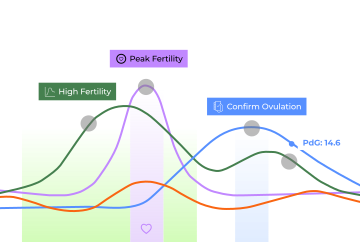
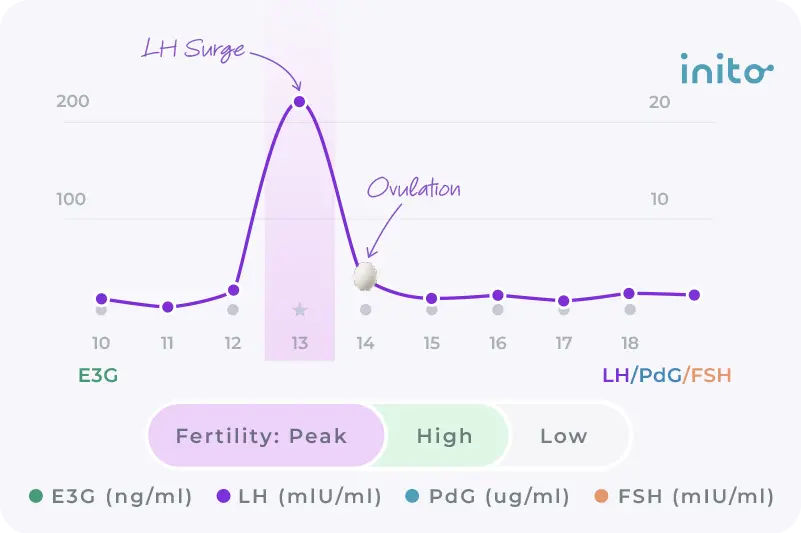
Finding it difficult to pinpoint these symptoms? Or just want to be sure that you’re actually ovulating after stopping your birth control? Then tracking your hormones with a fertility monitor like Inito can be a huge help.
On top of helping you predict your fertile window by giving you values for your LH, estrogen, and FSH, the Inito monitor tracks your levels of PdG. PdG is the urine metabolite of progesterone, the hormone that rises after ovulation. So tracking your PdG with Inito will help you be able to tell when you start ovulating again. No more guessing!
Now, the return of ovulation is one thing. But the return of your period is another.So what happens if you don’t get your period after ending your contraception?
Let’s discuss.
What if I Don't Get a Period After Going off Birth Control?
Waiting around for Aunt Flo to make her first appearance post-birth control can be nerve-wracking.
But it’s important to keep in mind that ovulation happens before menstrual bleeding. This means if you have unprotected sex before you get your first period, there’s a chance you could be pregnant.
So if you’ve been expecting your period to come by now and it hasn’t, try taking a pregnancy test. If it’s negative, your period could be just around the corner. If it still doesn’t come after a few days, take another pregnancy test.
At that point, if you still have concerns about a potential pregnancy or your period not returning? Reach out to your doctor for guidance on the next steps.
Now, let’s say you’re in the opposite scenario. Your period has returned and you’re actively TTC, but it’s just not happening. That can be anxiety-inducing too. Read the next section to see what to do in this case.
What if You're Unable to Get Pregnant After Getting off Birth Control?
The processes of conception and implantation are very intricate. At each stage of the process, the conditions must be just right for pregnancy to be successful.
All that’s to say, when you first go off birth control, try your best to be patient. Conceiving naturally can take some time. But it doesn’t necessarily mean there’s cause for concern.
If you’ve been having unprotected intercourse for months on end with no luck, though? Then it may be time to schedule an appointment with a fertility specialist.
Here are the suggested timelines for when to consult a doctor about your fertility:
- Less than 35 years – after a year of actively trying to get pregnant
- 35+ years – after six months of trying to get pregnant
Even if you haven’t quite reached these timelines, you can still check in with your doctor. It’s your reproductive health, so do what you feel is right for you!

FAQs
The birth control pill, vaginal rings, and intrauterine devices (IUDs) are only effective when you’re using them. Once you stop using birth control, ovulation resumes as usual, there’s a chance you can get pregnant.
After you stop taking your birth control pills, you could start ovulating within a few days up to a few months.
An injectable birth control like the Depo-Provera® shot suppresses ovulation for about 4 to 5 months. This means after getting your last shot, it could take about that amount of time for ovulation to resume. Once ovulation returns, you can get pregnant.
Once you stop taking your BC, the hormones leave your system pretty immediately. But it may take a few days up to a few months for your natural hormone levels to return to a stable state.
The likelihood that you’ll get pregnant right after stopping birth control depends on a few factors. These include your age and health, which method of birth control you were on, how regular your cycle is, and how regularly you have sex. You can get pregnant as soon as you begin ovulating again, and ovulation can happen as early as a few days after ending birth control.
The number of days that birth control is still effective after stopping depends on the precise type of birth control you were on. With hormonal birth control pills, it could take a few days or weeks for your hormone levels to go back to normal. In the case of hormonal IUDs, ovulation may take longer to resume. And if you were on Depo-Provera®, it can take as long as 6-8 months for ovulation to resume.
After stopping the pill, you can resume ovulation within a few days to a few months. It really depends on how regular your menstrual cycle was before going on the pill, as well as your overall health and fertility.
The amount of time it takes birth control to leave your system is fairly immediate. What can take a little longer is how long it takes your hormone levels to stabilize. It may take a few days to a few months for your hormones to return to their normal state. The exact length of time depends largely on the type of birth control you were on—like hormonal birth control pills vs. an IUD vs. an injectable shot, for example.
How long birth control stays effective after you stop using it really depends on the specific pill you were on. For some pills like progestin-only pills, protection may only last up to 2 days. For combined progestin and estrogen pills, it is longer. And on Depo-Provera®, protection can last for 6-8 months. For the best guidance on your exact situation, check in with the pharmacist o,r healthcare provider who prescribed your birth control.
The after pill can stay in your system for about 5 – 6 days. Before taking any sort of emergency contraception, be sure to read the label carefully and use it according to the manufacturer’s guidance. It’s also best to check with your healthcare provider or a pharmacist for more specific guidance if you have concerns.
The amount of time after stopping until you can get pregnant depends on your method of contraception. With methods like the pill, an IUD, patches, or rings, ovulation can return within that first month. The exception is injectable birth control. If you take the Depo-Provera® shot, it can take months until you can get pregnant since it suppresses ovulation for a longer period of time.
To “flush” birth control out of your system, you simply stop taking it. If you take hormonal birth control pills, the extra hormones leave your system within a day or so once your kidneys and liver have processed them. What can take a little longer is the length of time it takes for your natural hormone levels to recalibrate. This process can take closer to a couple of weeks or longer, depending on the exact birth control method you were using.
- Characteristics of the Menstrual Cycle After Discontinuation of Oral Contraceptives | Journal of Women’s Health
- Return of ovulation following a single injection of depo-medroxyprogesterone acetate: A pharmacokinetic and pharmacodynamic study – ScienceDirect
- Pre-gravid oral contraceptive use and time to pregnancy: a Danish prospective cohort study | Human Reproduction | Oxford Academic
- Return of fertility after discontinuation of contraception: a systematic review and meta-analysis