
Content table
Trying to conceive (TTC) often comes with an overwhelming amount of fertility advice. Unfortunately, much of what we’ve been taught about fertility is built on oversimplified averages, not real biology.
Ovulation doesn’t follow a calendar. Hormones don’t behave the same way every month. And a positive ovulation test doesn’t always mean an egg was released.
In this blog, we’ll break down the most common fertility myths, explain the science behind what really happens in your body, and show how hormone-based tracking can replace guesswork with clarity.
Key Takeaways
- Ovulation timing can vary widely, and the “Day 14” ovulation assumption often leads to an incorrect/missed fertile window.
- Ovulation tests can be misleading due to multiple LH surges, average thresholds, and false positives.
- A positive ovulation test predicts ovulation but does not confirm that it actually occurred.
- Hormone tracking provides more accurate insight than calendar apps, BBT, or cervical mucus alone.
- Tracking real hormone patterns with Inito helps identify fertile days sooner and reduces guesswork when trying to conceive.
Myth 1: “Every Woman Ovulates on Day 14 of Her Cycle”
What does the actual science say?
This is one of the most persistent fertility myths (and one of the most misleading).
While textbooks often describe a “typical” 28-day cycle with ovulation on Day 14, the normal cycle length varies between 21 and 35 days. In fact, a study involving data from more than 600,000 cycles found that menstrual cycles don’t follow the same timeline. While 65% of cycles fell between 25–30 days, many were shorter or longer, showing that variation is a normal part of cycle biology.
Here’s what cycle length variation looked like:
Cycle length range (days) | % of cycles |
15-20 | <1 |
21-24 | 8 |
25-30 | 65 |
31-35 | 19 |
36-50 | 7 |
The largest source of variation in cycle length comes from the follicular phase—the part of your cycle before ovulation. This phase is driven by hormones, like FSH, estrogen, and LH, which dictate follicular development and eventual egg release. Factors that can affect follicular phase length include:
- Stress
- Sleep
- Illness
- Travel
- Weight changes
- Age
Know more: Why Does My Period Date Change Every Month?
Why does this matter?
If you assume ovulation always happens on Day 14:
- You may miss your actual fertile window
- You may be trying at the wrong time in your cycle
- Calendar-based apps become unreliable guesses, not measurements
The Inito edge
Inito doesn’t rely on averages or assumptions. It:
- Establishes your personal hormone baseline
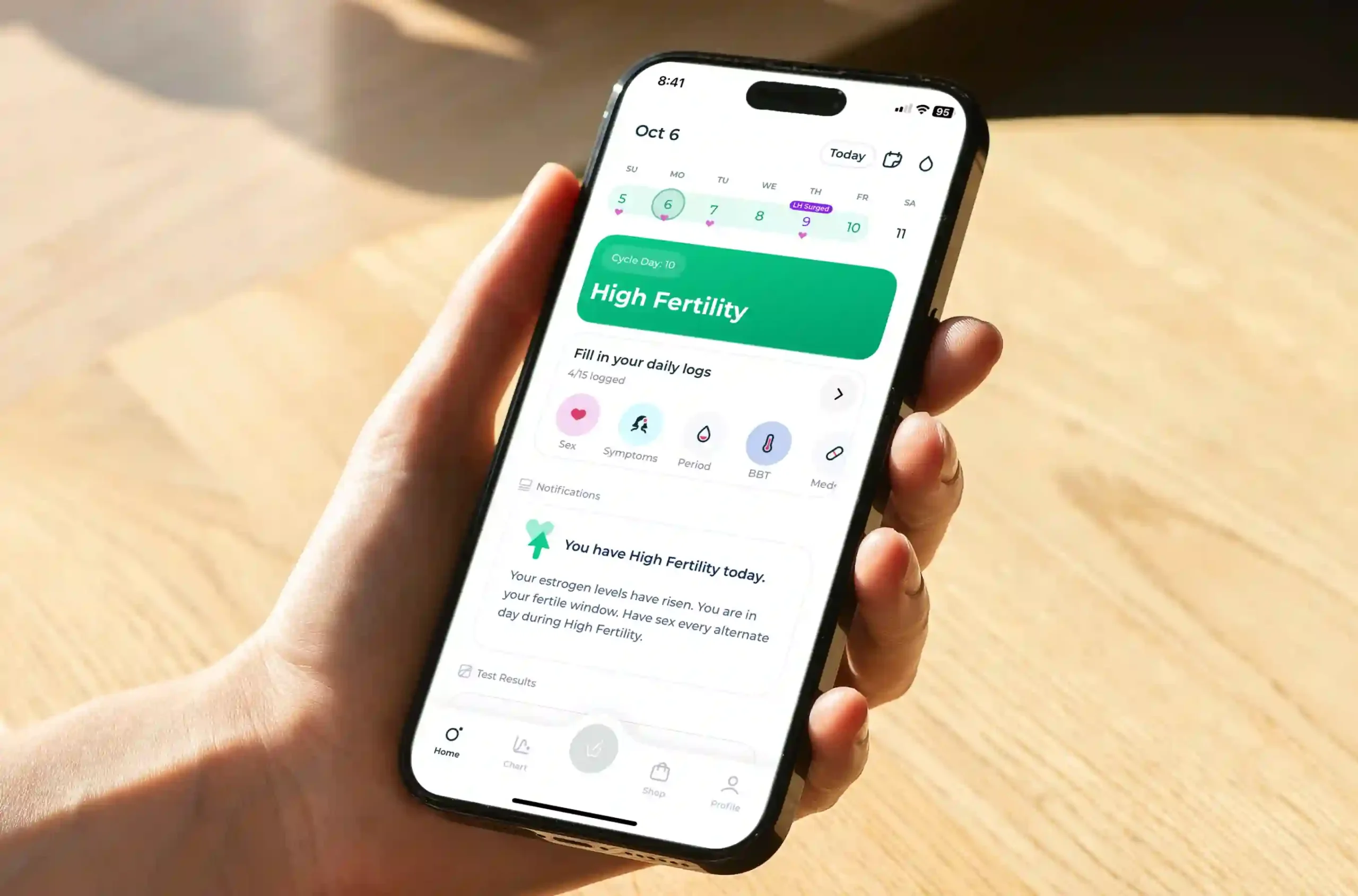
- Tracks real-time changes in LH, estrogen, PdG (urine metabolite of progesterone), and FSH
- Adapts to cycle-to-cycle variation instead of forcing you into ‘28-day cycle with a Day-14’ model
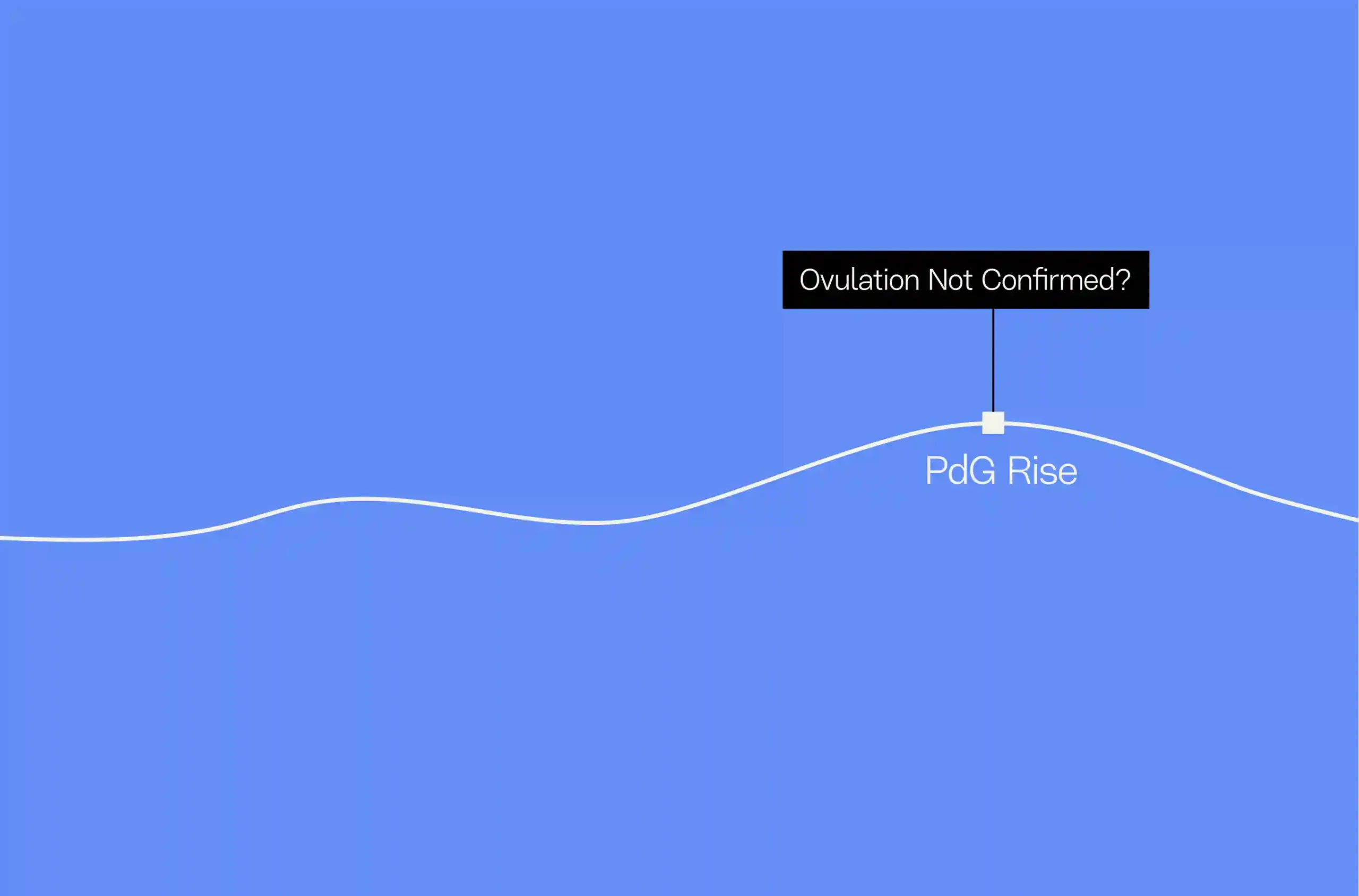
- Confirms ovulation using a sustained rise in PdG
Instead of guessing, you’re measuring what’s actually happening in your body.
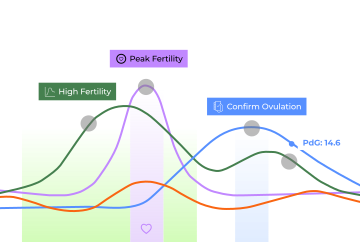
See how your hormone chart might look like!
Answer some questions to help us provide you a free personalized hormone chart customized to your hormonal health and conditions
Myth 2: “OPKs Accurately Tell You Exactly When You’re Ovulating”
What does the actual science say?
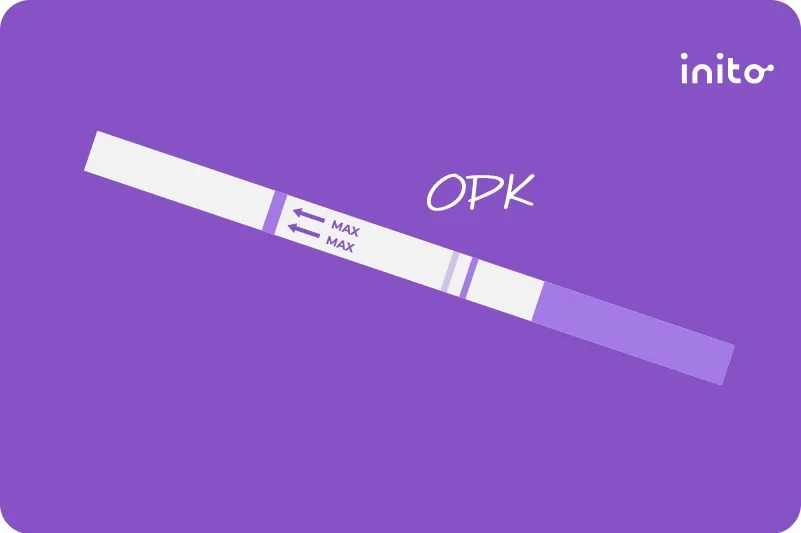
OPKs work by detecting LH in your urine. They turn positive when LH crosses a certain value, but this approach has several important limitations:
- Double, multiple, or prolonged LH surges can be confusing, making it unclear which surge actually triggered ovulation.
- OPKs detect the alpha subunit of LH, increasing the risk of cross-reactivity with hormones like FSH, TSH, or hCG and resulting in false positives.
Know more: 6 Reasons Why Your Ovulation Test Shows False Positive - Line-based tests are subjective and often misread, leading to inconsistent or incorrect interpretation of results (such as line eyes).
Why does this matter?
When OPKs confine you to narrow thresholds, don’t factor in your unique LH pattern, and involve self-interpretation, it’s easy to miss the true surge that actually triggers ovulation—increasing the chances of mistiming intercourse.
Know more: When to Have Sex to Conceive
The Inito edge
Inito has several advantages over OPKs. It:
- Detects the beta subunit of LH which reduces chances of cross-reactivity
- Gives you results based on your unique values, not arbitrary thresholds
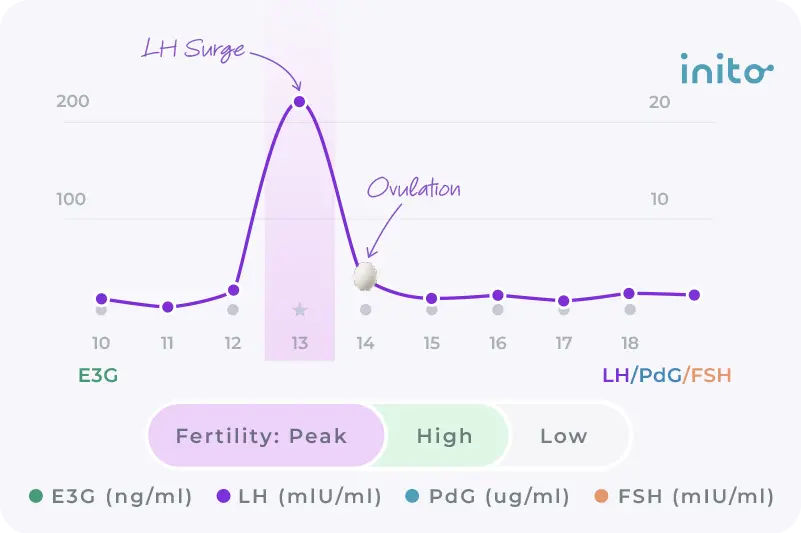
- Shows actual LH values and charts, not just positive/negative
- Lets you see your unique surge pattern – whether single, double, biphasic, multiple or plateau
Myth 3: “A Positive Ovulation Test Means You Definitely Ovulated”
What does the actual science say?
An LH surge predicts ovulation—but it doesn’t confirm it.
Sometimes:
- LH rises
- But the follicle may not release an egg
This results in an anovulatory cycle. Anovulation is more common than you think; in fact, about 30% of female infertility is due to not ovulating.
A lot of people believe that an LH surge = egg release. But, ovulation can only be confirmed when:
- The follicle becomes a corpus luteum
- Progesterone is released
- Progesterone metabolizes into PdG
- PdG shows a steady and consistent rise
But in anovulation,
No egg → no corpus luteum → no progesterone → no PdG rise
Know more: PdG Test: What It Is + How to Tell If You Need One
Special case: PCOS
In PCOS, LH is often chronically elevated. In fact, about 60% of PCOS patients have elevated LH. However, due to elevated androgen levels, follicle maturation doesn’t actually occur. So, OPKs may look “positive,” even when the egg is not being released.
The Inito edge
Inito confirms ovulation by tracking a steady and consistent rise in PdG after the LH surge, so you know whether egg release actually happened—not just whether your body attempted to ovulate.
Know your chances of Ovulation!
Take our ovulation quiz to understand how your hormone patterns and
lifestyle factors may affect your chances of ovulating

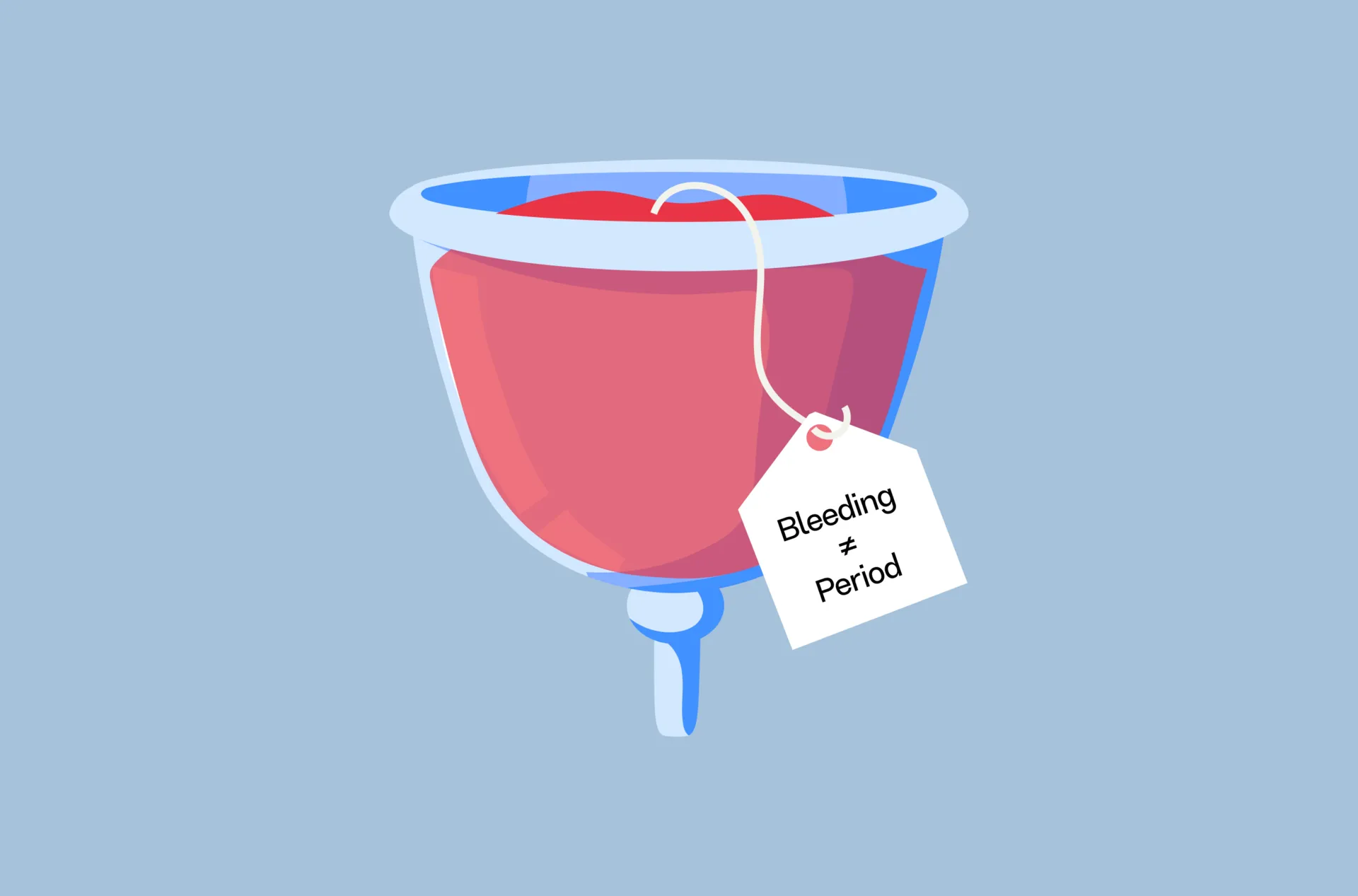
Myth 4: “Any Bleeding Means It’s Your Period”
What does the actual science say?
Not all bleeding is a true period. In an anovulatory cycle:
Ovulation doesn’t occur → Progesterone is never produced → Estrogen remains unopposed → The uterine lining grows under estrogen alone → The lining eventually sheds unpredictably
This is called breakthrough bleeding, which can be:
- Irregular
- Prolonged
- Easily mistaken for a period
Know more: The 8 Types of Abnormal Menstruation You Should Know About
The Inito edge
If you bleed but PdG never rises, Inito can reveal that ovulation didn’t occur. This is something that calendar apps or OPKs can’t do, since they don’t actually measure your PdG levels.
Myth 5: “BBT Precisely Confirms Ovulation”
What does the actual science say?
Basal Body Temperature (BBT) rises by 0.5-1 degree Fahrenheit after ovulation, due to the release of progesterone. Progesterone causes the brain’s thermostat to ‘reset’, leading to an increase in body temperature.
But there are certain limitations:
It’s retrospective (BBT rise only happens after ovulation, so it can’t help with timing intercourse during your fertile window)
Affected by illness, alcohol, stress, travel, and other factors
Accuracy can be as low as 22%
In summary, BBT shows the effect of ovulation—not the cause.
Know more: Basal Body Temperature for Fertility Tracking: Reliable or Not?
The Inito edge
- Confirms ovulation with a steady and consistent rise in PdG
- Helps time intercourse by also tracking 3 other fertility hormones, which predict your true fertile window
Myth 6: “Cervical Mucus Tracking Alone Is Enough”
What does the actual science say?
Cervical mucus changes are an effect of rising estrogen—not the cause.
Problems with only relying on cervical mucus to track ovulation:
- It can be subjective
- Some women may naturally produce lesser cervical mucus
- Influenced by hydration, infections, stress, or medications
- Only predicts that ovulation is approaching, doesn’t guarantee it
Know more: What Does Your Cervical Mucus Tell You About Your Body?
The Inito edge
Inito tracks the urine metabolite of estrogen, identifying High Fertility days as soon as estrogen rises. It also measures 3 other fertility hormones including LH, which helps predict ovulation and gives you a complete picture of your fertile window.
Myth 7: “Women Can’t Get Pregnant After 35”
What does the actual science say?
Fertility declines gradually—not suddenly. While egg quality and quantity decline, many women conceive naturally later in life.
Why tracking matters more with age
As perimenopause approaches, cycles can become more erratic, making ovulation harder to predict. After 35, when egg reserves are naturally declining, getting the timing right may seem more challenging.
Know more: What is a Geriatric Pregnancy? TTC When You’re Older
The Inito edge
By tracking estrogen, LH, PdG, and FSH together, Inito helps ensure you don’t miss critical fertile days—especially when every cycle counts. It also helps confirm if ovulation has actually occurred.
Myth 8: “Fertility Tracking Is Only for Irregular Cycles”
What does the actual science say?
Even if your cycles seem “regular,” ovulation timing can still shift from month to month due to factors like stress, illness, or medication. Without tracking real hormone changes, it’s easy to miss key fertile days.
Accurate timing also helps reduce the wait in understanding if conception is happening naturally or if extra medical support might be needed.
Research shows that without fertility awareness, many couples take several months to conceive—about half within three months, 75% by six months, and over 90% within a year. In contrast, when intercourse is timed using fertility awareness, conception often happens sooner. One study found that 76% of couples conceived in the very first month, with nearly all conceiving within seven months.
The Inito edge
By tracking your real hormone patterns to both predict and confirm ovulation, Inito takes the guesswork out of fertility tracking. And if conception doesn’t happen within a reasonable time frame, this clarity allows you to seek the right support sooner rather than waiting longer than needed.
Final Takeaway: Replace Myths With Measurements
Fertility isn’t broken—it’s misunderstood. Most frustration comes from relying on averages, thresholds, assumptions, and single-hormone tracking tools.
When you measure what actually matters—real hormone patterns over time—fertility becomes clear, precise, and empowering.