

Content table
For many people going through IVF, the idea of daily injections can feel overwhelming. And this isn’t an uncommon concern. Research suggests that more than half of IVF patients have concerns about the injection process, while some may even delay fertility treatment because of a fear of needles.
This is one reason researchers have explored needle-free IVF. But despite the name, needle-free IVF doesn’t necessarily mean going through the entire IVF process without a single needle. Instead, it generally refers to methods that reduce or eliminate repeated needle injections.
So, how do these approaches work, and are they as effective as traditional IVF injections? Here’s what the research tells us so far.
Key Takeaways
- Needle-free IVF helps reduce or avoid repeated needle injections during ovarian stimulation.
- It doesn’t always mean completely needle-free. Instead, it involves different ways to reduce needle use.
- Early research has found that needle-free IVF can successfully deliver fertility medications, but there isn’t enough evidence to say that these are overall as effective as conventional injections.
- The biggest potential benefit is reducing injection burden.
- This method may be particularly helpful for people who experience pain, anxiety, or fear around repeated injections.
- Some approaches may still require an initial needle placement, and other parts of IVF, such as egg retrieval, may still involve needles.
What Is Needle-Free IVF?
Needle-free IVF isn’t a separate type of IVF. Instead, it describes different approaches that can reduce the number of needle sticks needed during ovarian stimulation. These can include needle-free jet injectors and subcutaneous infusion catheters.
During a traditional IVF cycle, ovarian stimulation usually involves about 1-2 weeks of daily hormone injections. These medications, called gonadotropins, stimulate the ovaries to develop multiple follicles so that several eggs may be available for retrieval.
Needle-free or needle-reducing systems change how these medications are delivered, rather than changing the basic IVF process itself.
It’s also important to know that needle-free IVF doesn’t always mean completely needle-free treatment. Egg retrieval and other parts of IVF may still involve needles, and some needle-reducing systems require one initial needle insertion.
Know more: IVF Process: Your Step-by-Step Guide from Start to Finish
Why Was Needle-Free IVF Developed?
Needle-related fear is common and can actually be a significant concern during fertility treatment.
One study of 102 IVF patients found that:
- 33.7% said needles factored into their decision to pursue IVF.
- 18.6% reported delaying treatment because of their fear of needles.
- 20.6% scored at a level indicating potential symptoms of a needle phobia.
In fact, injection-related anxiety ranked as the third most significant IVF-related worry in the study, after concerns about egg or embryo numbers and treatment costs.
Another study found that 57% of IVF patients had concerns about the injection process. Research involving 488 people undergoing infertility treatment also found that approximately one-third experienced anxiety or lacked confidence when self-administering fertility medications.
So, needle-free and needle-reducing systems can be ways to:
- Reduce pain from repeated injections
- Ease needle-related anxiety
- Reduce accidental needle-stick injuries
- Reduce the need for conventional sharps disposal
The goal is generally to reduce the burden of repeated IVF injections while still delivering the medications needed for ovarian stimulation.
What Are the Types of Needle-Free IVF?
There isn’t one standardized treatment called “needle-free IVF.” Instead, researchers have explored different ways of reducing repeated needle sticks, which include needle-free jet injectors and subcutaneous catheters.
How do needle-free jet injectors work?
Needle-free jet injectors deliver fertility medication through the skin using a very fine, high-pressure stream instead of a traditional needle.
Some of the earliest systems studied for IVF included the J-Tip Needle-Free Injection System and the Biojector 2000 CO₂ Injection System.
These use pressurized carbon dioxide (CO₂) to propel medication through the skin and into the tissue underneath it, where the medication can be absorbed. Because these devices can be self-administered and only takes a few seconds, patients may be able to use them at home for ovarian-stimulation medications, much like conventional fertility injections.
How do subcutaneous infusion catheters work?
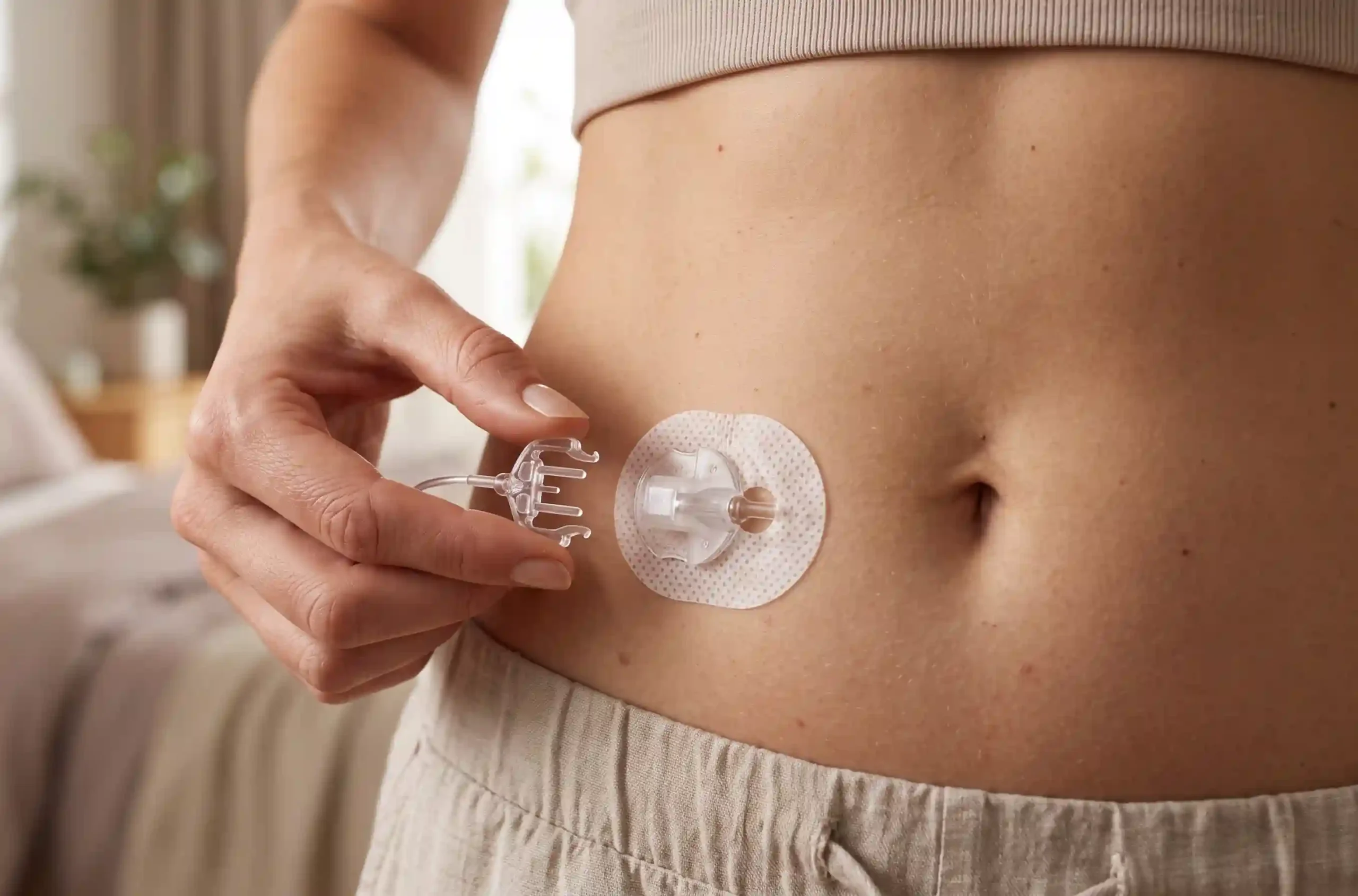
A subcutaneous infusion catheter works by allowing multiple fertility medications to be administered through a single catheter.
A small adhesive device containing a soft, flexible catheter is placed under the skin. Unlike a true needle-free injector, placing the catheter generally requires one initial needle insertion. Once it is in place, however, medications can be administered through the catheter instead of inserting a new needle each time.
This can considerably reduce the number of needle sticks during ovarian stimulation. Early research suggests that this may be particularly appealing to people who experience needle anxiety, although clinical evidence is still limited.
What Does Research Say About Needle-Free IVF?
Early research suggests that needle-free systems can deliver fertility medications during IVF, but the evidence is still limited. Most studies so far have been small, so larger studies are needed to understand how these methods compare with traditional injections. Here’s what researchers have found so far:
1. Needle-free injectors can deliver fertility medications
Studies of needle-free jet injectors, including J-Tip and Biojector systems, have found that they can be used to deliver gonadotropins during ovarian stimulation.
In one randomized study, a needle-free CO₂ injection system produced comparable clinical outcomes to conventional injections. Other small pilot studies have also shown that ovarian stimulation could be successfully completed using needle-free systems.
However, some of these studies didn’t include a conventional-injection comparison group, so they can’t tell us whether the methods are equally effective.
2. They may reduce pain or needle anxiety
Some studies have reported minimal or reduced pain with needle-free systems.
A small study of a subcutaneous infusion catheter also found that participants felt it reduced their needle-related anxiety and was easy to use. The catheter still required an initial needle placement, but it reduced the need for repeated injections throughout ovarian stimulation.
3. We still need larger studies
While the results so far are encouraging, needle-free medication delivery during IVF is still an emerging area of research.
Many studies have included only a small number of participants, and different needle-free technologies have been studied separately. More research is needed before they can be considered a routine alternative to traditional IVF injections.
What Are the Benefits of Needle-Free IVF?
Some of the main benefits of needle-free IVF are:
- Fewer needle sticks: Jet injectors avoid traditional needles for medication delivery, while catheter systems can reduce repeated injections.
- Less needle-related anxiety: This may make ovarian stimulation less stressful for people who are uncomfortable with needles.
- Potentially less pain: Some studies have reported minimal or reduced pain with needle-free systems, although they aren’t necessarily pain-free.
- Fewer sharps to manage: Reducing conventional injections can mean fewer needles to handle and dispose of.
What Are the Limitations of Needle-Free IVF?
Some of the biggest limitations of needle-free IVF include:
- May cost more: Needle-free injectors may cost more than standard needles and syringes. One study estimated costs of £1.50-£2.00 per device, compared with just a few pence for a standard needle and syringe (Since these estimates come from older research, current costs may differ).
- Technique matters: Correct technique is important for proper medication delivery. One study reported that 18% of injections had to be repeated due to administration issues.
- May not be suitable for everyone: Some needle-free devices may be more difficult to use for people with limited hand movement, arthritis, or visual impairment.
- May not be preferred by everyone: Avoiding needles doesn’t necessarily mean a better treatment experience for everyone. One randomized study found that overall patient satisfaction wasn’t significantly higher with a needle-free system than with conventional injections.
Is Mini IVF Needle-Free?
Mini IVF isn’t completely needle-free, but it may involve fewer fertility injections than conventional IVF.
Mini IVF, also known as mild or minimal-stimulation IVF, typically uses lower doses of fertility medications and may rely more heavily on oral medications such as letrozole or clomiphene citrate.
This can reduce the dose and number of injectable medications needed.
However, mini IVF shouldn’t be considered the same thing as a needle-free injection system. It changes the ovarian-stimulation protocol, whereas jet injectors and infusion catheters change how medication is administered.
Other steps of IVF, including the trigger and egg retrieval process, may still involve needles or medical procedures.
How Does Needle-Free IVF Compare With Regular IVF and Mini IVF?
The biggest difference is how much needle use is involved and why it is reduced.
Feature | Regular IVF | Mini IVF | Needle-Free IVF |
Medication delivery | Daily injections with needles and syringes | Lower medication doses and fewer injections | May use a needle-free jet injector or subcutaneous catheter |
Needle use | Repeated needle sticks during stimulation | Usually fewer needle sticks | May avoid repeated needles; some methods require one initial needle placement |
Medication dose | Typically higher stimulation doses | Lower-dose stimulation | Depends on the IVF protocol; the delivery device itself doesn’t determine the dose |
Egg retrieval | Generally aims to retrieve multiple eggs | Often results in fewer eggs | Depends on the stimulation protocol rather than the injection method |
Needle anxiety | Repeated injections may be challenging | Fewer injections may reduce the burden | Specifically designed to reduce or avoid repeated needle sticks |
Success rates | Established; varies by individual factors | May be lower in some studies | Limited data; no established success rate |
The key distinction is that mini IVF and needle-free IVF solve different problems of conventional IVF. Mini IVF reduces the amount of ovarian-stimulation medication used. Needle-free IVF primarily changes how the medication enters the body.
Who Might Consider Needle-Free IVF?
Needle-free or needle-reducing IVF approaches may be worth discussing with a fertility specialist for people who find repeated injections particularly difficult or experience significant needle anxiety.
However, suitability depends on the medications being used, the stimulation protocol, available devices, and the fertility clinic. Because these technologies aren’t yet established as the standard method of IVF medication delivery, availability may also be limited.
Is Needle-Free IVF Widely Available?
Needle-free IVF isn’t currently a standard option at every fertility clinic. Much of the research into jet injectors and catheter-based medication delivery has involved relatively small studies, and availability can vary between clinics and locations.
If repeated injections are a major concern, you can ask your fertility clinic what options they offer for reducing the number of needle sticks during ovarian stimulation.
The Bottom Line
Needle-free IVF is less about eliminating every needle from IVF and more about reducing the repeated injections that can make ovarian stimulation challenging for some people.
So far, small studies suggest that some needle-free systems can successfully deliver fertility medications and may produce ovarian response and IVF outcomes comparable with conventional injections.
But the evidence is still early. Larger controlled studies are needed to understand their effectiveness, safety, cost, and patient experience before needle-free systems become a routine alternative to traditional IVF injections.

FAQs
Not completely. Needle-free IVF involves some ovarian-stimulation medications to be given without traditional needles. However, other parts of IVF, including egg retrieval, may still involve needles or medical procedures.
Some small studies have found similar ovarian response, egg retrieval, medication use, and pregnancy outcomes with some needle-free systems compared with conventional injections. However, there isn’t enough large-scale evidence yet to conclude that needle-free medication delivery is equally effective for everyone undergoing IVF.
Not necessarily. Some studies have reported less pain with needle-free injectors, but they aren’t guaranteed to be painless. Pressure during administration and local skin reactions may still cause discomfort.
Yes. Needle-free IVF involves alternative ways to administer gonadotropins used for ovarian stimulation. The medication itself may therefore be similar; it’s the delivery method that changes.
Some small studies have successfully administered gonadotropins using needle-free jet injection systems. However, these devices aren’t currently the standard method of delivering IVF medications, and availability may vary.
No. Mini IVF uses lower doses of ovarian-stimulation medication and may require fewer injections. Needle-free IVF systems change how medications are delivered. Mini IVF can reduce injection burden, but it isn’t necessarily needle-free.
Using needle-free IVF may not necessarily reduce the risk of ovarian hyperstimulation syndrome (aka OHSS). OHSS risk is related more closely to factors such as ovarian response and the stimulation protocol than whether medication is delivered with a needle or a needle-free device.
There isn’t a standard cost for needle-free IVF. Device costs, clinic fees, medications, and availability can vary. Some studies found needle-free injectors were more expensive per administration than conventional needles and syringes, but these figures shouldn’t be used to estimate current IVF treatment costs.
Reducing repeated needle sticks may make ovarian stimulation easier for some people with needle anxiety. Early research on catheter systems has reported reduced needle anxiety among participants, but the best approach should be discussed with the fertility clinic based on the treatment protocol and available options.
- The J-Tip Needle-Free Injection System in controlled ovarian hyperstimulation in in vitro fertilization: a pilot study – ScienceDirect
- Patient satisfaction and clinical outcome after injecting gonadotropins with use of a needle-free carbon dioxide injection system for controlled ovarian hyperstimulation for in vitro fertilization – Fertility and Sterility
- L26/P-871 Needle-free administration of gonadotropins in IVF cycles: a pilot study | Human Reproduction | Oxford Academic
- Mild stimulation for in vitro fertilization – PubMed
- NEEDLE ANXIETY IN PATIENTS PURSUING IVF: HOW BIG OF AN ISSUE IS IT? – Fertility and Sterility
- Understanding the burden of ovarian stimulation: fertility expert and patient perceptions – PubMed
- Patient perceptions and understanding of treatment instructions for ovarian stimulation during infertility treatment – PubMed
- Mild Stimulation Protocol | Springer Nature Link