

Content table
Summary
Yes, ovulation can be confirmed at home. InSight Wireless Reader ™, a variant of the Inito Fertility Monitor, helps do this by tracking a sustained rise in PdG (the urine metabolite of progesterone) after ovulation. Published studies in Nature’s Scientific Reports Journal show that Inito confirms ovulation with over 99% specificity and 92.2% precision.
Most ovulation tests stop at prediction. Inito goes a step further by tracking hormone changes across your cycle, before, during, and after ovulation, so you can understand what actually happened in your cycle, not just what was expected.
What Does Ovulation Confirmation Actually Mean?
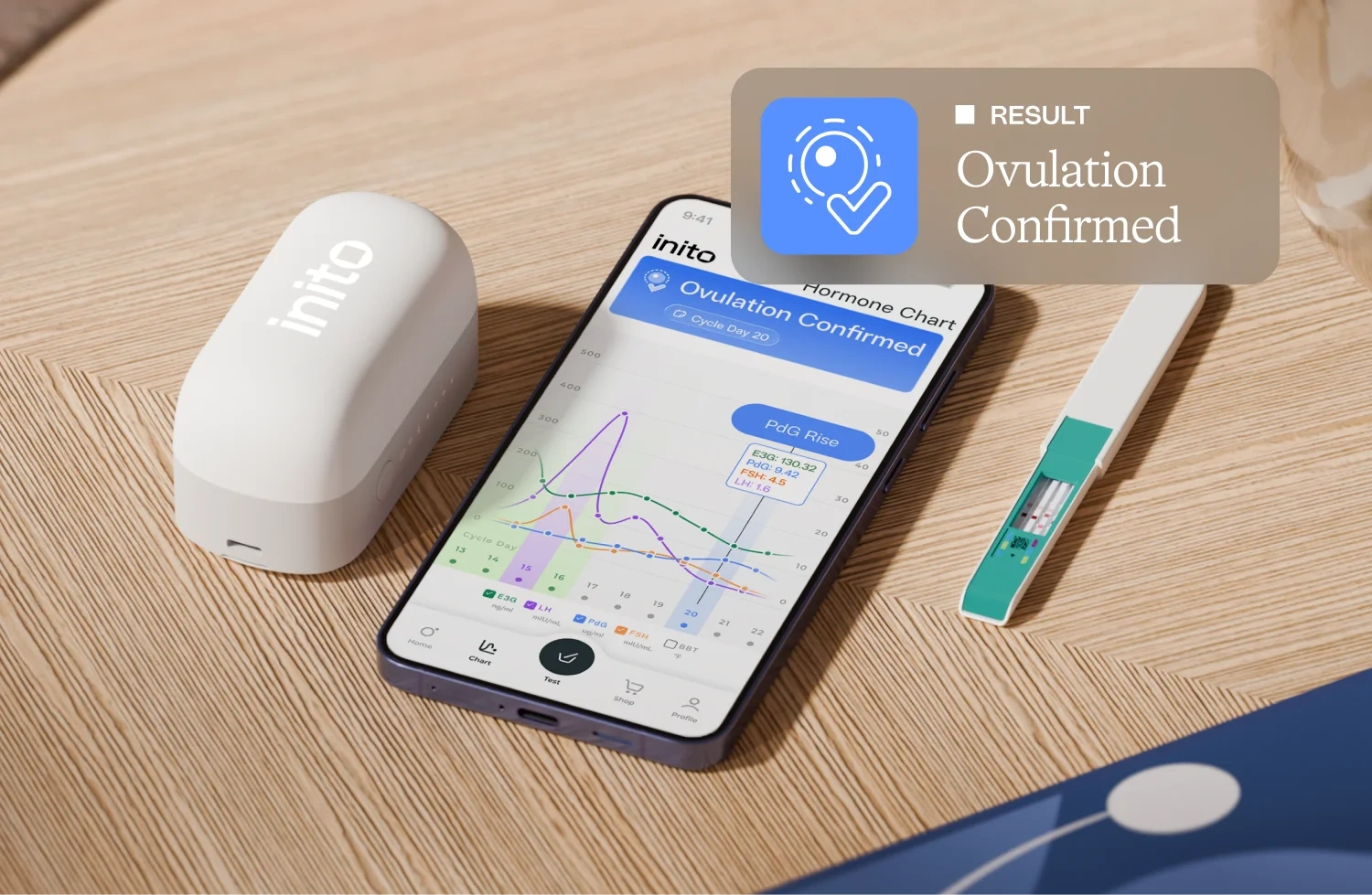
Ovulation confirmation means knowing your body has actually released an egg in a given cycle, not just that it might.
Prediction tells you ovulation may happen soon. Confirmation tells you ovulation has already happened.
That distinction matters more than most people realize—especially when you’re trying to conceive and every cycle counts.
With Inito, you can track ovulation based on real hormone changes, not just a surge.
LH Surge vs PdG Rise: What’s the Difference?
Understanding ovulation confirmation starts with understanding how these two hormones behave.
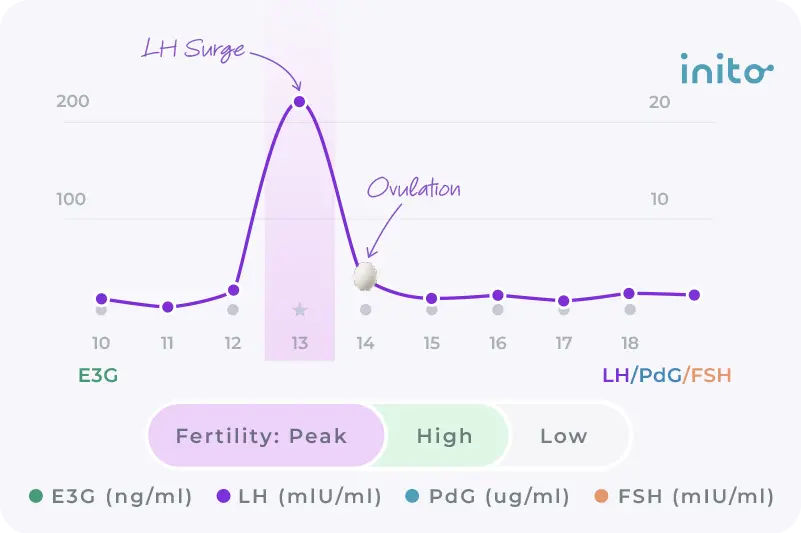
LH (Luteinizing Hormone) rises before ovulation. It acts as a signal that your body is preparing to release an egg.
But LH is not a proof. It tells you your body is attempting to ovulate. It does not confirm that ovulation actually happened.
Know more: How Does LH Surge Impact Ovulation?
This is why it is possible to have an LH surge and still not ovulate, particularly in cases of hormonal imbalance or PCOS.
PdG (urine metabolite of progesterone) rises after ovulation.
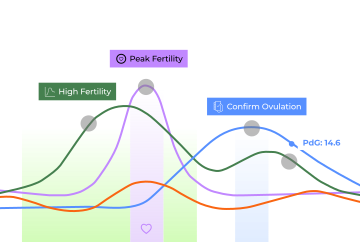
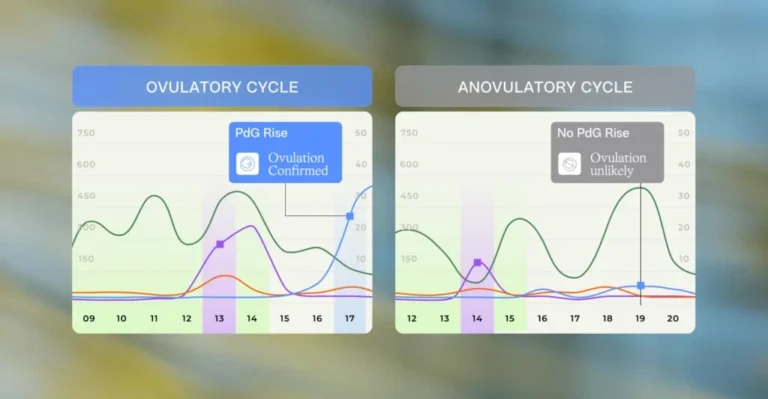
Once ovulation occurs, progesterone increases. PdG reflects this rise in urine, and when it increases steadily over multiple days, it becomes a biological confirmation that ovulation has already happened.
In simple terms: LH = prediction | PdG = confirmation
Know more: Progesterone vs. PdG Test: Is There a Difference?
How Does Inito Confirm Ovulation?
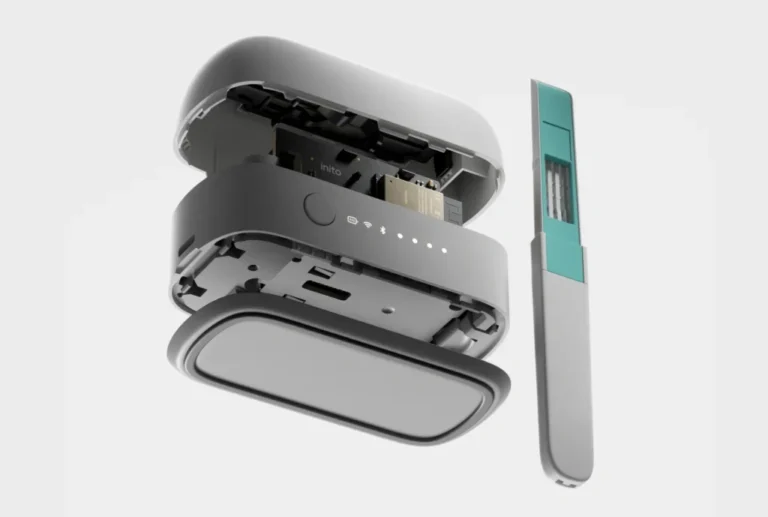
The InSight Wireless Reader™, a variant of the Inito Fertility Monitor, is designed to deliver the most precise1 hormone readings at home, so PdG patterns can be tracked more clearly over a few days.
After ovulation, progesterone production increases. Inito measures PdG daily and looks for a sustained rise from your personal baseline across multiple days.
That means:
- no one-day spikes
- no symbolic guesses
- no reliance on a single reading
Instead, ovulation is treated as a process that unfolds over time, not a single moment.
Want to understand the research behind how ovulation is confirmed? Read our clinical validation guide →
What Users Say About Confirming Ovulation with Inito
“I loved being able to see my baseline hormone levels in my follicular phase since I’ve never known these numbers before. The Inito monitor helped me during the TTC process because it showed both my alpha and beta LH levels. This helped us pinpoint my actual ovulation day. It turns out in the traditional OPKs, the ‘peak’ fertility was showing 2 days prior to what the Inito data showed. The Inito monitor used my hormone levels over multiple data points to determine when my actual peak fertility was. I absolutely loved being able to test post my LH surge for a rise in PdG to confirm ovulation. This was extremely reassuring during the two week wait when stress and anxiety can take a toll on your emotions. It was reassuring to know that my body successfully ovulated.”
— Kendra Best
Why Does This Matter When You’re Trying to Conceive?
Trying to conceive isn’t just about identifying your fertile window. It’s also about knowing whether ovulation is happening consistently and whether you make enough progesterone to support an implantation.
Without confirmation, you are often left wondering: “Did it actually happen?”
For many, this uncertainty is common.
Without ovulation confirmation, you may:
- spend multiple cycles guessing
- feel unsure if your timing was correct
- not realize when ovulation isn’t happening
Inito helps close that gap by showing what your hormones actually did, not just what they were expected to do.
“I am 36 and my husband is 42 so we are on the older side for having our first baby! The Inito monitor is an incredible tool for the journey because you can see what is going well or even things that you may need to address. Being able to confirm ovulation was a game changer in feeling confident you are tracking correctly and that there is hope. And hope is such an important thing, especially when some months can feel so discouraging.”
— Felicia Haul
How Does Inito Help You Move Forward With More Clarity?
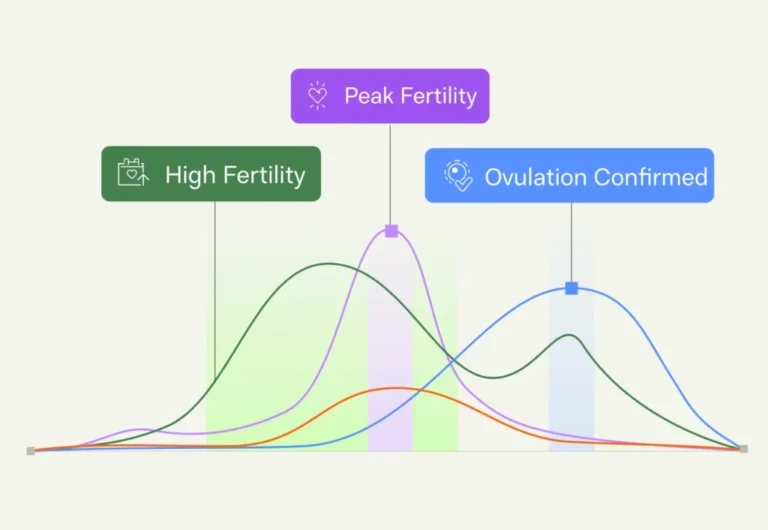
By confirming ovulation through a sustained PdG rise, Inito helps you:
- understand whether a cycle was truly ovulatory
- reduce uncertainty after your fertile window
- see patterns across cycles, not just single days
This can mean more confidence in what your body did this cycle, and clearer next steps for the one ahead.
How Does At-Home Confirmation Compare to Other Methods?
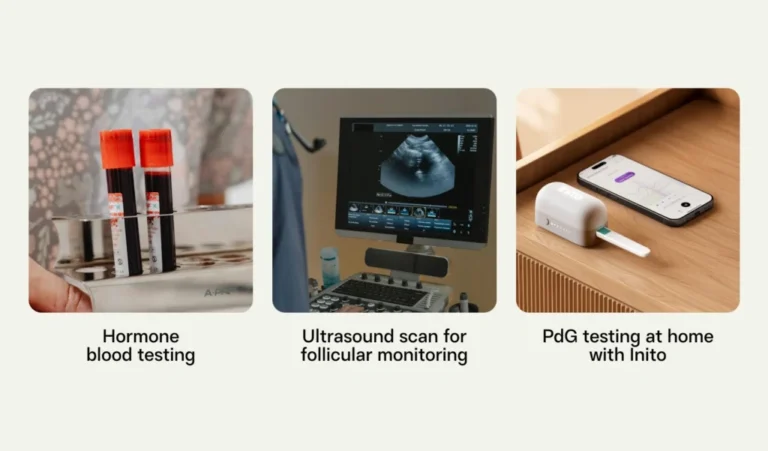
Ovulation can traditionally be confirmed in three ways:
- Blood progesterone testing
- Done around 7 days after ovulation
- Requires a lab visit and a doctor’s appointment
- Progesterone is released in pulses and fluctuates throughout the day, affecting results
- Ultrasound scan for follicular monitoring
- Requires multiple clinic visits
- Expensive and time-intensive
- PdG Testing at Home with Inito
- Tracks the urine metabolite of progesterone daily
- Looks for a sustained rise over several days and is able to accurately confirm if ovulation has happened
- Non-invasive and convenient, done at home
- Provides precise, cycle-wide hormone data across four key fertility hormones
- Spectral Mapping technology double-checks every result, giving you results you can trust
Because Inito tracks four key fertility hormones on one strip and looks at sustained hormone patterns over time, it offers a precise way to understand whether ovulation actually happened.
What Changes When You Can Confirm Ovulation?
Most tools tell you ovulation might happen. Inito is designed to help show whether it actually did.
When you know ovulation has happened, you can:
- Adjust your timing on the right days to try
- Identify potential issues earlier on, such as anovulatory cycles, or a luteal phase that may be shorter than expected, giving you and your doctor something concrete to act on
- Feel more reassured about your TTC journey, and be able to move forward with clarity and confidence.
“I heard about Inito on social media, mainly on TikTok and TTC forums and Facebook pages. After seeing women find success and mostly due to the fact it can confirm ovulation and show PdG levels, it made me want to dive in and try it. Inito helped by confirming ovulation and by tracking four different hormones, which ultimately gave more fertile days than traditional methods do. I think my favorite part of Inito is testing PdG (Progesterone) and Estrogen because it showed the beginning of the window with Estrogen, and then confirmed with PdG.”
— Heidi Girolamo

FAQs
Ovulation is confirmed by a sustained rise in PdG (urine metabolite of progesterone) after ovulation. This rise over a few days shows that ovulation has already happened.
Because prediction isn’t enough. Confirming ovulation tells you whether your body actually released an egg, helping you understand your timing and next steps.
Inito tracks PdG levels daily and looks for a consistent rise from your baseline over multiple days. Ovulation is confirmed only when this rise is sustained.
For a deeper look at the research behind this method, read our clinical validation guide.
PdG usually rises a few days after ovulation and peaks around 6–8 days later, but in some cycles it can take longer. If ovulation isn’t confirmed in one to two cycles, it can be normal. If it happens repeatedly, it’s worth discussing with your doctor.
Yes. LH acts as the trigger signal for ovulation, but does not confirm that the egg was released. In conditions such as PCOS or other hormonal imbalances, multiple LH surges can occur without ovulation following. In fact, 25.5% of Inito users report seeing more than one LH surge in a single cycle (data based on an internal survey). Only a sustained PdG rise confirms that ovulation occurred.
PdG typically starts rising a few days after your LH surge and peaks around 6–8 days post-ovulation. It may take up to 9 days to confirm ovulation on Inito. After this, if there is no rise in PdG levels, you may have an anovulatory cycle.
Published studies in Nature’s Scientific Reports Journal show that Inito’s hormone patterns have about 95% correlation2 with blood hormone trends, and confirms ovulation with over 99% specificity.
Want to understand how this was studied? Read our clinical validation guide
Yes. By tracking multiple hormones, Inito helps interpret patterns more clearly in cycles where LH alone may be confusing, such as PCOS or irregular cycles. Its analysis is built on over 40M+ hormone data points, allowing it to better recognize patterns across a wide range of cycle types.
Most fertility monitors track one hormone and predict ovulation. Inito tracks four hormones and can confirm ovulation by measuring hormone patterns across your cycle.
Disclaimer
1 “Most precise” refers to system‑level precision measured in controlled laboratory testing, based on lower between‑device variability across key hormones, concentrations, operators, days, and strip lots. Compares Inito to other U.S. over-the-counter at‑home fertility monitors that provide numeric or graded hormone values and measure the same hormones as Inito.
2Accuracy may be reduced in irregular cycles, anovulatory cycles, or when hormone levels are affected by medical conditions, medications, or inconsistent testing. “95% accuracy to corresponding blood hormone trends” refers to published findings showing that Inito’s urinary hormone measurements closely matched the direction and pattern of corresponding serum hormone changes over time. It does not mean urine values are identical to blood values or that absolute urine and blood hormone numbers will match exactly.