


Content table
Precision matters because fertility is not a snapshot. It is a sequence.
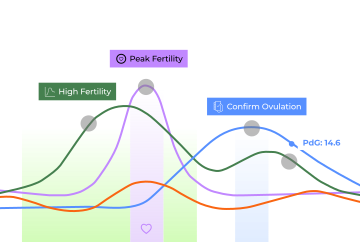
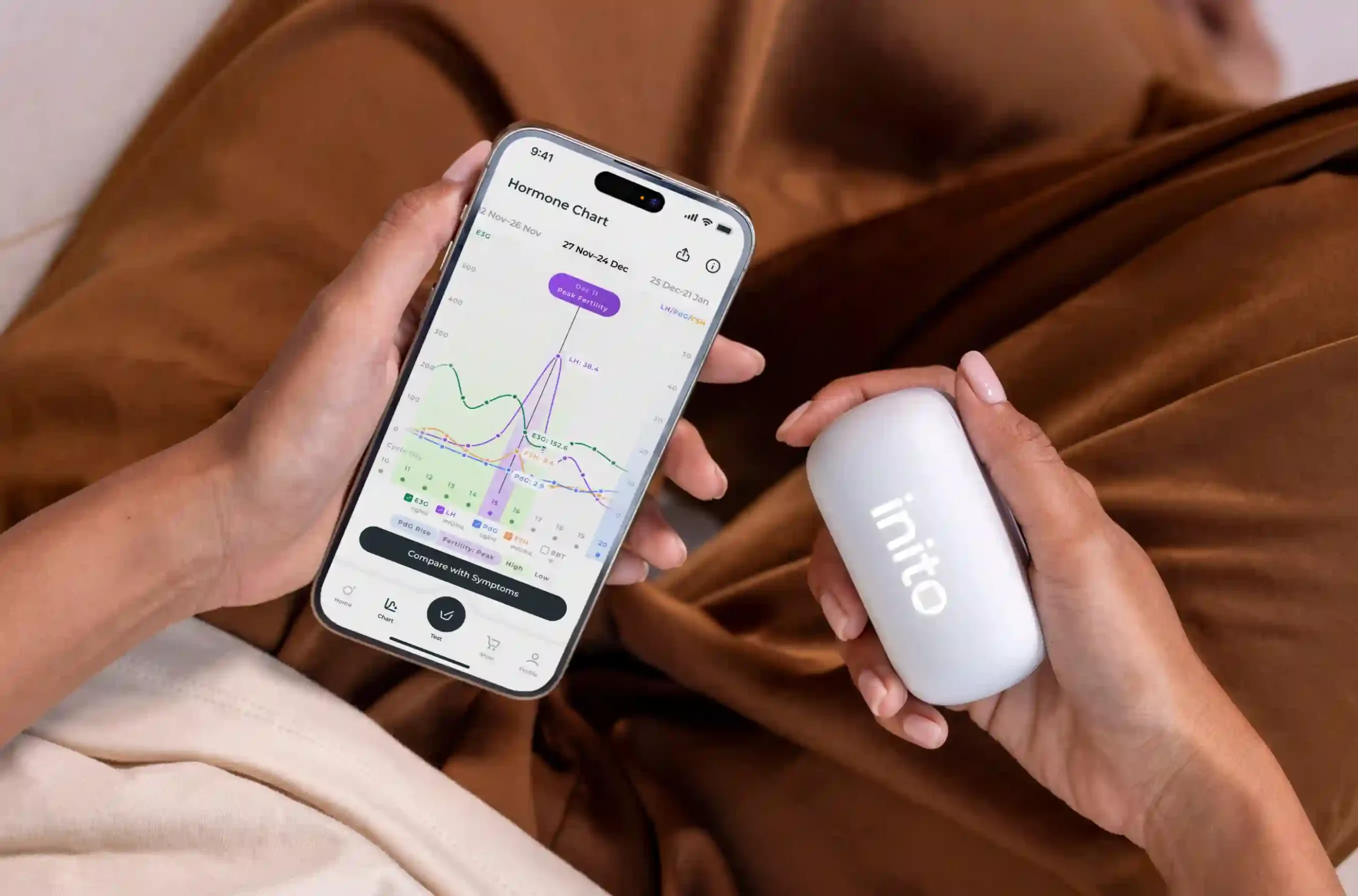
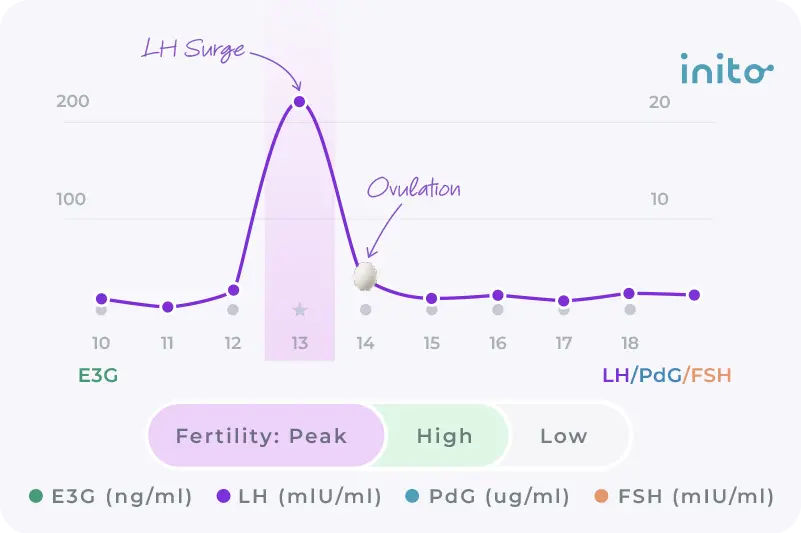
Hormones rise, peak, fall, and sustain across your cycle. A single reading on a single day can only tell you so much. What matters is the pattern.
That is why precision matters.
When readings are more precise, hormone trends become clearer. And when trends are clearer, it becomes easier to understand what is actually happening in your body. That is the foundation we built Inito on.
What our published research found
Our published research shows three important things.
First, in a published study in Nature’s Scientific Reports Journal, Inito’s urinary E3G, PdG, and LH assays showed less than 15% variability across lots. That means the readings stayed steady rather than jumping around. A level considered to be acceptable for home-use diagnostic systems under standards such as ISO 15197.
Second, the same study found no cross-reactivity with the urinary metabolites tested at the highest physiological concentrations evaluated. In simple terms, the signal stayed focused on the hormones being measured, not other compounds that may also be present.
Third, a published study in Oxford Academic’s Human Reproduction Open found that Inito’s urine hormone patterns closely matched corresponding serum hormone trends with 95% accuracy1. The reported R² values were 0.96 for E3G and estradiol, 0.95 for PdG and progesterone, and 0.98 for LH. In a separate verification cohort, those correlations remained high.
Together, these findings suggest that the hormone trends seen on Inito are not just readings on a strip. They are consistent, specific, and meaningfully aligned with the underlying hormone changes happening in the body.
Why precision matters
Precision is not just about a better number on one day. It is about clearer hormone trends across many days.
When readings stay steady, it becomes easier to see whether a hormone is actually rising, peaking, or falling. When the signal stays specific, it becomes easier to trust that the result reflects the hormone being measured.
For you, that means fewer to no mixed signals and more confidence in what your body is doing across the cycle.
So, is Inito precise?
Based on our published research, yes.
In published validation testing, Inito demonstrated high assay precision, with average CVs below 15% across lots for E3G, LH, and PdG. In published interference testing, our strips showed no cross-reactivity with the urinary metabolites tested. And in a separate serum-correlation study, our urinary hormone patterns showed strong alignment with corresponding serum hormone trends, with 95% accuracy1.
With InSight Wireless Reader™, precision goes further
This published foundation matters on its own. And with InSight Wireless Reader™, we build on it even further.
Powered by patented Spectral Mapping Technology, InSight Wireless Reader™ is designed to measure fertility hormones with most precision at home, validated in controlled head-to-head laboratory testing, Inito delivered the most precise fertility hormone readings at home in the US.
This is not just about a better device. It is about making hormone tracking more dependable, more consistent, and more useful cycle after cycle.
Disclaimer: 1 – Accuracy may be reduced in irregular cycles, anovulatory cycles, or when hormone levels are affected by medical conditions, medications, or inconsistent testing. “95% accuracy to corresponding blood hormone trends” refers to published findings showing that Inito’s urinary hormone measurements closely matched the direction and pattern of corresponding serum hormone changes over time. It does not mean urine values are identical to blood values or that absolute urine and blood hormone numbers will match exactly.

FAQs
Yes. Published studies show that Inito measures urinary fertility hormones with high precision.
A Scientific Reports study found less than 15% variability across lots for E3G, LH, and PdG, and no cross-reactivity with the urinary metabolites tested.
Because steadier readings create clearer hormone trends.
It means readings that stay consistent, stay specific, and reflect real hormone patterns more clearly over time.